Do Pool Robots Clean the Waterline?

Short answer

Some do: 38 of the 52 robots here list waterline cleaning. But a robot that "climbs walls" does not necessarily scrub the waterline — it may turn back a few inches below it. Look for a waterline mode or waterline scrubbing by name, and for a horizontal pass along the tile line rather than a vertical climb to it.

Walls and the waterline are different jobs

Climbing a wall is a traction problem. Scrubbing the waterline is a control problem: the robot has to reach the top of the wall, hold there with its brush half out of the water, and travel sideways along the tile without breaking the surface and losing suction. Many robots that climb walls reverse before they reach the tile line, which is why the grey ring survives a robot that does everything else well.

Makers who have solved it say so by name — a waterline-only mode, a dual pass along the waterline, horizontal waterline scrubbing. A spec sheet that says only “floor and walls” is telling you the waterline is still yours to brush.
What a robot can and cannot do about the ring

The ring is mostly body oils, sunscreen and the pollen and dust that float, bonded to the tile. A robot's brush loosens it before it hardens; it does not remove scale that has already calcified, which needs a tile cleaner or pumice. Running a waterline pass a few times a week keeps the ring from forming, which is a better use of the feature than asking it to remove a season's worth.

Surface skimmers attack the same problem from the other side, catching the floating debris before it reaches the tile. 5 floor robots here also skim the surface themselves.

Robots this comes up with

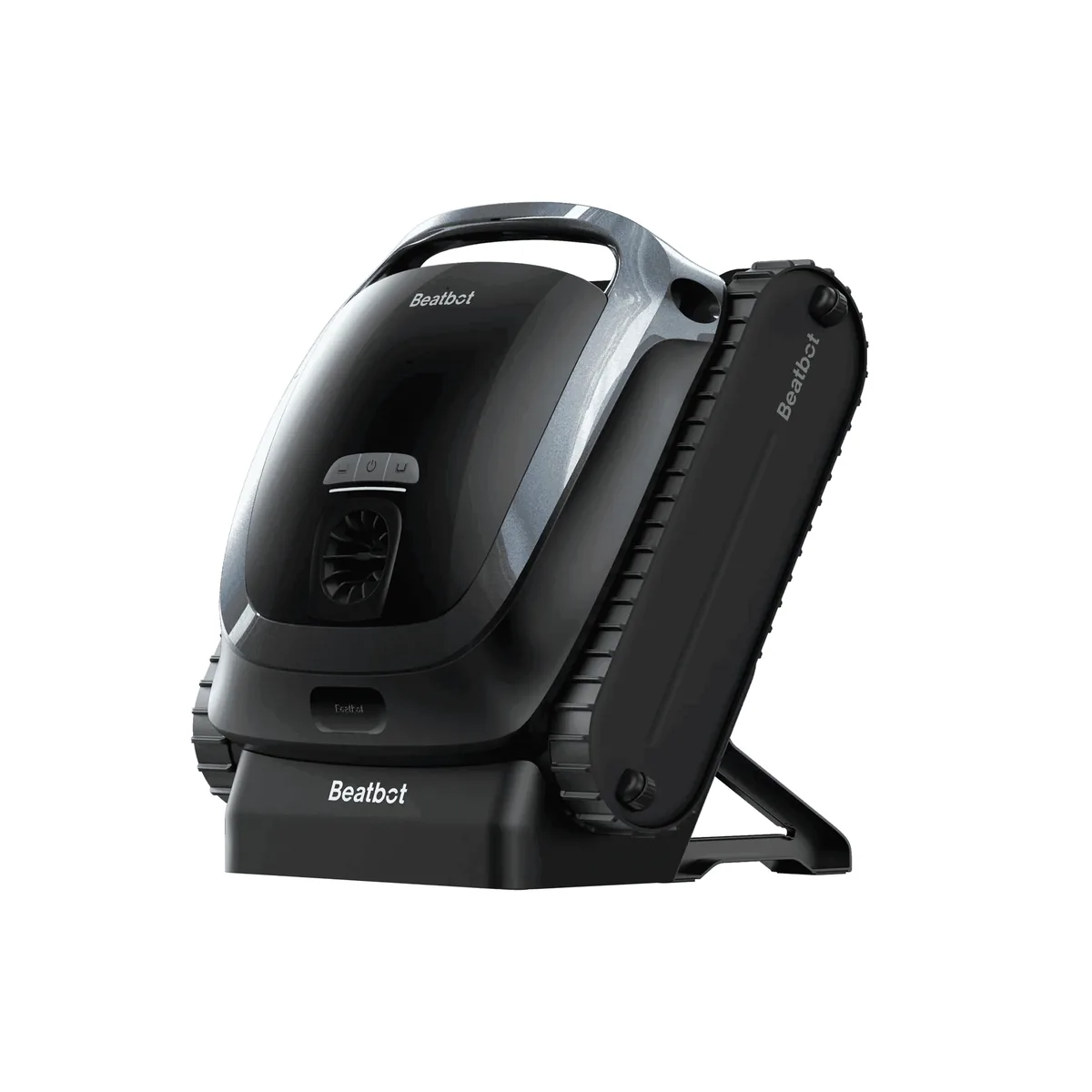
Beatbot AquaSense 2 robotic pool cleaner
Beatbot~$799

Beatbot AquaSense 2

Cordless floor+wall+waterline · 240 min, floor only

Pool fit
~79 ft (floor only)
Filtration
150 µm · sand, grit and leaves
Retrieval
Parks for pickup · 23.1 lb
  • 4 h floor runtime
  • Wireless dock
  • 3-year warranty

Cleans: Floor, walls, waterline

Related

  • What a Pool Robot's Micron Rating Means

    The micron rating is the smallest particle the robot's filter is rated to catch. Leaves and bugs are caught by anything; sand needs roughly 200 µm or finer; pollen and silt sit around 10–100 µm; the fine dust and early algae that cloud water are under 50 µm. Of the 24 robots here whose maker publishes a figure, the median is 150 µm — sand and grit, not dust. 28 publish none.

  • Are Pool Robots Safe on Vinyl Liners?

    Yes, provided the maker lists vinyl. A robot has no hard wheels dragging on the liner the way some suction cleaners do, and most use rubber, PVC or foam brushes that are soft on vinyl. The things that damage liners are grit trapped under a brush, robots climbing onto vinyl-covered steps, and wrinkles that a robot catches on — none of which is specific to one brand.

  • Reading a pool robot spec sheet

    Every specification explained, with the numbers from the catalog behind each one.